
Flattening yield curve implications set the stage for this enthralling narrative, offering readers a glimpse into a story that is rich in detail and brimming with originality. Exploring historical instances and economic slowdown signals, this topic delves deep into the world of finance with clarity and insight.
Flattening Yield Curve Implications
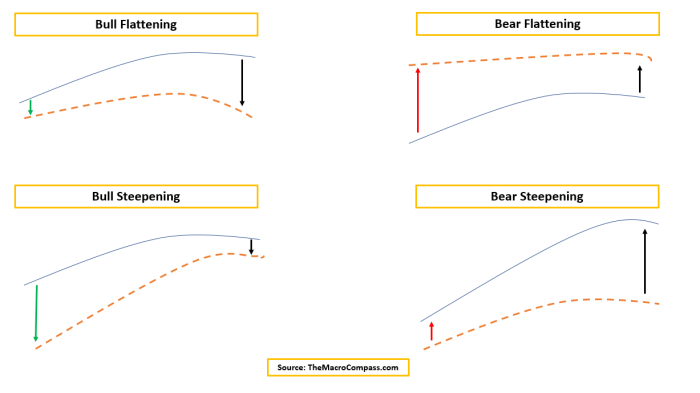
When we talk about a flattening yield curve in finance, we are referring to a situation where the difference between short-term and long-term interest rates narrows. This often occurs when long-term interest rates decrease or remain stable while short-term rates increase. In simpler terms, the yield curve is flattening out, showing less difference between short and long-term borrowing costs.
Historical Instances of Flattening Yield Curves
One notable historical instance of a flattening yield curve was prior to the 2008 financial crisis. The yield curve flattened as short-term rates increased due to Federal Reserve tightening, while long-term rates remained subdued. This flattening curve signaled an economic slowdown, ultimately leading to the recession.
Impact on the Economy
- A flattening yield curve may signal an impending economic slowdown or even a recession. This is because it reflects investor concerns about the future health of the economy, leading to lower long-term interest rates.
- Businesses may become more cautious in their investments and hiring decisions, anticipating weaker economic conditions ahead.
- Consumers might also pull back on spending, fearing potential job losses or income reductions in a slowing economy.
Implications for Investors
- Investors closely monitor the yield curve as a potential indicator of future economic conditions. A flattening curve could prompt them to adjust their investment strategies to prepare for a downturn.
- Fixed-income investors may find it challenging to earn higher returns in a flattening yield curve environment, as long-term bond yields may be lower than expected.
- Stock market investors may see increased market volatility and shifts in sector performance as the economy adjusts to the implications of a flattening yield curve.
Yield Curve Overview
A yield curve is a graphical representation of the interest rates on debt for a range of maturities. It shows the relationship between the interest rate and the time to maturity of the debt. Typically, the yield curve plots the yields of Treasury securities.
The different types of yield curves are normal, inverted, and flat. A normal yield curve slopes upwards from left to right, indicating that long-term interest rates are higher than short-term rates. An inverted yield curve, on the other hand, slopes downwards, with short-term rates higher than long-term rates. Lastly, a flat yield curve shows little to no difference between short-term and long-term rates.
The yield curve is significant as it serves as an indicator of economic conditions and market expectations. A normal yield curve suggests a healthy economy, as investors demand higher compensation for long-term investments. In contrast, an inverted yield curve is often seen as a precursor to an economic recession, signaling that investors expect lower interest rates in the future.
Types of Yield Curves
- A normal yield curve: Represents a healthy economy with higher long-term interest rates.
- An inverted yield curve: Indicates potential economic downturn with higher short-term rates.
- A flat yield curve: Shows uncertainty in the market with minimal difference between short-term and long-term rates.
In conclusion, the discussion on flattening yield curve implications sheds light on its crucial role as an economic indicator and a guide for investors. With a clear understanding of its significance, readers can navigate the complex landscape of finance with confidence and foresight.
Questions Often Asked
What does a flattening yield curve signify?
A flattening yield curve may indicate an economic slowdown, affecting investor decisions.
Can a flattening yield curve have a positive impact?
While it often signals economic challenges, it can also offer opportunities for strategic investments.
How do investors typically respond to a flattening yield curve?
Investors may adjust their portfolios by diversifying assets or shifting towards defensive investments.


